
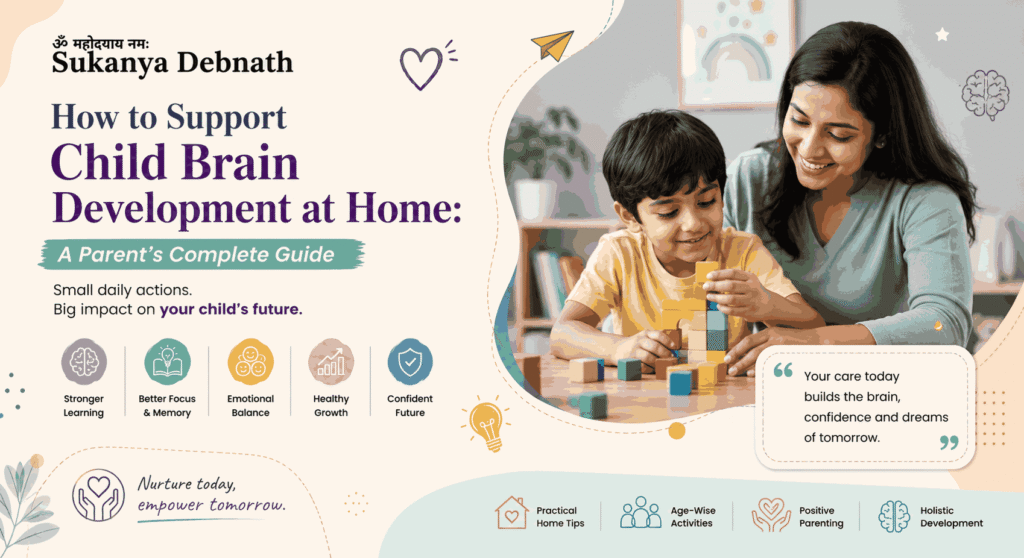
Child development begins with everyday experiences. Simple activities such as talking, playing, reading, exploring, eating together, and spending quality time with your child can create valuable opportunities for learning and growth. Parents do not need expensive toys or complicated learning programmes to encourage healthy child brain development.
Every child develops at their own pace, so the goal is not to compare children or expect instant results. Instead, parents can create a warm, supportive home environment where children feel safe to ask questions, make mistakes, explore their interests, and build new skills.
What Is Child Brain Development?
Child brain development includes the gradual development of skills that help children think, communicate, learn, interact, and manage emotions.
It includes:
- Cognitive skills such as thinking and problem-solving
- Language and communication skills
- Emotional awareness and regulation
- Social interaction
- Memory and attention
- Motor skills and coordination
Development happens through many experiences rather than one specific activity. Everyday interactions between parents and children can therefore play an important role.
Create a Supportive Home Environment
A child’s home environment can influence how comfortable they feel while exploring and learning.
Parents can create a supportive environment by:
- Listening to children without immediately judging them
- Keeping household expectations clear
- Allowing children to ask questions
- Giving age-appropriate choices
- Encouraging curiosity
- Providing opportunities for independent play
- Making time for family interaction
Children do not need a perfect home. They need consistent care, connection, encouragement, and opportunities to explore.
Talk and Listen Every Day
Regular conversation is one of the simplest ways to encourage language and thinking skills.
Parents can talk about everyday experiences:
“What did you see at the park today?”
“Which book should we read?”
“Why do you think that happened?”
For younger children, parents can name objects, describe activities, sing songs, and respond to sounds or gestures.
For older children, conversations can become more detailed. Ask them to explain their ideas, describe experiences, or share opinions.
Most importantly, give children time to respond instead of answering every question for them.
Make Reading a Daily Habit
Reading together can support language, listening, imagination, and communication.
Parents can make reading more interactive by:
- Letting children choose some books
- Discussing pictures
- Asking what might happen next
- Explaining unfamiliar words
- Connecting stories to real-life experiences
- Encouraging children to retell stories
Reading does not always have to follow a strict schedule. Even a short, consistent reading routine can become a meaningful parent-child activity.
Let Children Learn Through Play
Play is a natural way for children to explore ideas and practise different skills.
Useful activities include:
- Building blocks
- Puzzles
- Drawing
- Pretend play
- Clay or modelling
- Board games
- Simple crafts
- Story-based games
Parents do not need to control every part of play. Give children space to decide what they want to create and ask questions such as:
“Tell me about what you’re making.”
This encourages children to explain their thoughts and use their imagination.
Encourage Curiosity
Children learn by asking questions and exploring their surroundings.
When your child asks something you do not know, you can say:
“I’m not sure. Let’s find out together.”
This teaches children that not knowing an answer is simply an opportunity to learn.
Simple activities such as gardening, cooking, nature walks, building projects, and observing animals can encourage children to notice details and ask questions.
Support Emotional Development
Child development is not only about academic learning. Emotional skills are also important.
Parents can help children understand emotions by naming what they may be experiencing.
For example:
“You look disappointed because the game is finished.”
Acknowledging feelings does not mean accepting inappropriate behaviour. Parents can set boundaries while still showing understanding.
For example:
“It is okay to feel angry, but it is not okay to hit. Let’s talk about what happened.”
Build Emotional Safety at Home
Children benefit from knowing that they can talk to their parents about their experiences.
Parents can encourage emotional safety by:
- Listening calmly
- Avoiding humiliation when children make mistakes
- Keeping rules consistent
- Encouraging children to express concerns
- Spending individual time with each child
- Praising effort and persistence
- Showing affection in ways the child responds positively to
Parents also make mistakes. Apologising and repairing the relationship can teach children that mistakes can be acknowledged and resolved.
Support Healthy Sleep Routines
Sleep is an important part of children’s overall wellbeing.
A predictable bedtime routine can make evenings calmer. It might include:
- Finishing active play
- Completing bedtime hygiene
- Reducing stimulation
- Reading a story
- Having a quiet conversation
- Going to bed
Sleep needs differ according to age and individual circumstances. If parents have ongoing concerns about a child’s sleep, they can discuss them with an appropriately qualified healthcare professional.
Encourage Balanced Nutrition
A balanced diet supports children’s overall growth and wellbeing.
Parents can encourage variety by including appropriate foods from different food groups, such as:
- Fruits and vegetables
- Whole grains
- Protein-rich foods
- Dairy or suitable alternatives
- Healthy sources of fats
- Water and other appropriate fluids
Mealtimes can also become learning opportunities. Children can help wash vegetables, count ingredients, identify colours, or talk about different foods.
There is no need to focus on one particular food as a guaranteed “brain food.”
Manage Screen Time Thoughtfully
Screens are a normal part of modern life. Instead of focusing only on eliminating screens, parents can consider how and when children use them.
Think about:
- The child’s age
- The type of content
- Whether it is age-appropriate
- Whether parents can participate
- Whether screens are replacing sleep or physical activity
- Whether screen use is affecting family interaction
Creating predictable screen-time routines can help children understand when screens are appropriate and when other activities are expected.
Use Everyday Activities for Learning
Parents can support learning without turning the entire day into lessons.
While cooking
Children can count ingredients, follow simple instructions, and learn about colours and textures.
While shopping
They can identify familiar items, compare sizes, count objects, and make simple choices.
Outdoors
Children can observe plants, animals, weather, and changes in their surroundings.
During household tasks
Age-appropriate chores can encourage independence, coordination, responsibility, and following instructions.
These activities can be adjusted according to the child’s age and abilities.
Encourage Creativity
Creativity can develop through many forms of expression.
Encourage children to:
- Draw and paint
- Make crafts
- Create stories
- Build objects
- Dance
- Sing
- Play pretend games
- Design their own games
Try not to correct every creative choice. Instead of saying, “Trees are not that colour,” ask:
“Tell me about your picture.”
This gives the child an opportunity to explain their thinking.
Give Age-Appropriate Choices
Small choices can help children practise decision-making.
For younger children, ask:
“Would you like the blue shirt or the green shirt?”
Older children can gradually make decisions about books, hobbies, projects, activities, or simple responsibilities.
Choices should match the child’s age and ability. Too many options can sometimes become overwhelming.
Age-Appropriate Activities for Child Brain Development
| Age | Activity ideas | Skills encouraged |
| Babies | Talking, singing, cuddling, picture books, age-appropriate movement | Communication, sensory awareness, connection |
| Toddlers | Blocks, simple puzzles, songs, pretend play | Language, coordination, problem-solving |
| Preschoolers | Drawing, storytelling, sorting, building, crafts | Creativity, language, reasoning |
| Early school years | Reading, board games, hobbies, outdoor exploration | Concentration, communication, problem-solving |
| Older children | Projects, independent reading, discussions, planning activities | Critical thinking, independence, decision-making |
These are general suggestions. Children may develop skills at different times and may prefer different activities.
What Parents Do Not Need to Do
Supporting child brain development does not require parents to:
- Buy expensive educational toys
- Plan every minute of the day
- Turn every game into a lesson
- Compare their child with other children
- Remove every screen
- Expect advanced academic skills too early
- Create a completely stress-free home
Simple, consistent interactions are often easier to maintain than complicated routines.
When Should Parents Seek Professional Guidance?
Parents may consider professional guidance if they have continuing concerns about their child’s:
- Communication
- Learning
- Movement
- Hearing or vision
- Social interaction
- Behaviour
- Emotional wellbeing
- Sleep
- Everyday functioning
Depending on the concern, parents may speak with a paediatrician, educator, child psychologist, speech and language professional, occupational therapist, or another appropriately qualified professional.
Seeking guidance does not mean something is necessarily wrong. It can simply help parents understand their child’s individual needs.
A Simple Daily Routine for Development
Parents can focus on a few simple habits:
- Talk: Have conversations with your child.
- Read: Share books and stories.
- Play: Allow time for child-led play.
- Move: Include physical activity and outdoor time.
- Connect: Spend quality one-on-one time together.
- Rest: Maintain a predictable bedtime routine.
- Explore: Follow your child’s questions and interests.
- Encourage: Recognise effort, curiosity, kindness, and persistence.
These habits can fit naturally into family life without creating pressure.
Conclusion
Supporting child brain development does not require a perfect parenting strategy. Everyday moments talking, reading, playing, cooking, exploring, listening, and spending time together can provide meaningful opportunities for children to learn and grow.
The most important goal is to create a home where children feel safe, supported, encouraged, and curious. By combining connection with healthy routines and age-appropriate learning experiences, parents can give children a strong and supportive foundation for development.
Support Your Child’s Growth with the Right Guidance
Want to better understand your child’s needs and support their development at home? Connect with Sukanya Life Coach for practical parenting and child development guidance.
Frequently Asked Questions
1. How can parents support child brain development at home?
Parents can support development through regular conversation, reading, play, healthy routines, outdoor activities, emotional connection, and opportunities for children to explore and make age-appropriate choices.
2. Is play important for child brain development?
Yes. Play can give children opportunities to practise communication, creativity, problem-solving, coordination, imagination, and social interaction.
3. How does reading help children?
Shared reading can encourage language, vocabulary, listening, imagination, and communication. Asking questions about stories can make reading more interactive.
4. Do children need expensive educational toys?
No. Everyday objects, books, blocks, drawing materials, household activities, and outdoor experiences can all provide opportunities for learning.
5. How should parents handle screen time?
Parents can consider the child’s age, content, context, and whether screen use is interfering with sleep, physical activity, play, learning, or family interaction. Clear and consistent boundaries can be helpful.
6. Can nutrition support child development?
A varied and balanced diet contributes to children’s overall growth and wellbeing. Parents should focus on healthy eating patterns rather than relying on individual foods as guaranteed solutions.
7. When should parents seek professional guidance?
If parents have ongoing concerns about communication, learning, movement, behaviour, social interaction, sleep, or other areas of development, they can discuss those concerns with an appropriately qualified professional.
