
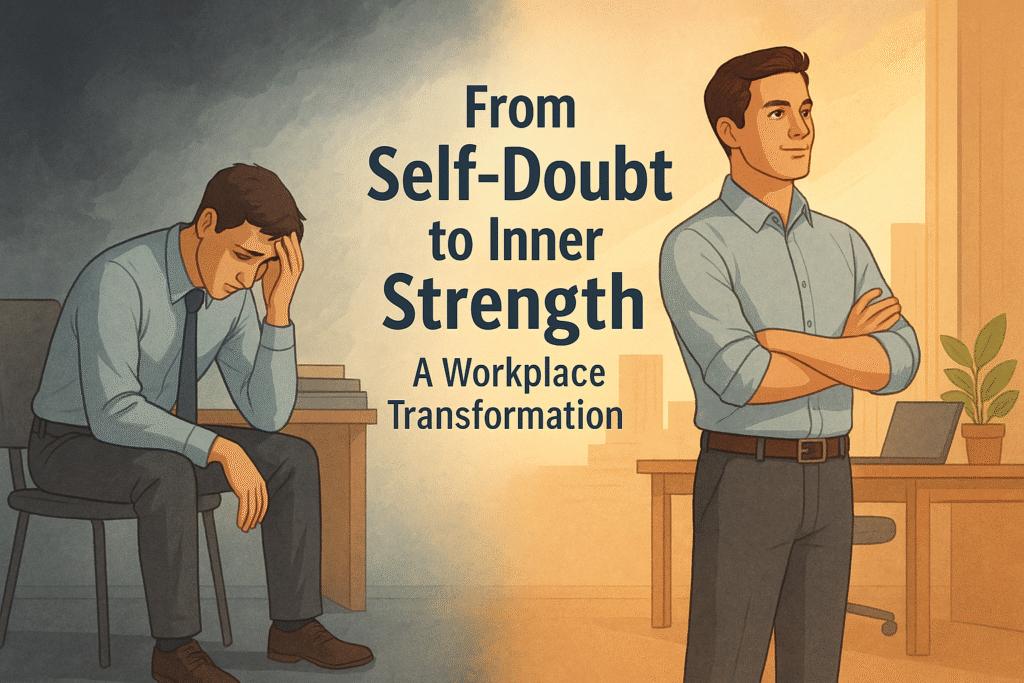
When people come to coaching, it’s rarely about the surface problem. It’s usually about the weight they’ve been carrying in silence — the thoughts, the emotions, and the constant inner battles that no one else can see. Rishav’s story is one such example of how a subtle but powerful shift in perspective can change everything.
When Rishav first came to me for coaching, he was deeply stressed and emotionally drained. His workplace had become a source of constant anxiety. It wasn’t the workload that troubled him the most — it was the way his colleagues treated him. The comments, the tone, the lack of empathy in day-to-day interactions had slowly chipped away at his confidence.
He shared that, at work, he would often hear remarks like:
“Why do you always take things so personally?”
or
“This is just how we work here—if you can’t handle the pressure, maybe it’s not the right place for you.”
At first glance, these might seem like passing comments, but for Rishav, they cut deep. These words stayed with him long after the office lights were turned off. On his way home, over dinner, and even while lying in bed, his mind would replay those statements. Slowly, he began to second-guess himself. “Am I too sensitive? Am I really not good enough? Maybe I don’t belong here at all.”
The result was a constant sense of confusion and self-doubt. His energy was drained, not because of the actual work he was doing, but because of the emotional toll of carrying these words within him.
In our coaching sessions, we started by acknowledging his feelings instead of brushing them aside. Often, the most powerful step is simply giving yourself permission to say, “Yes, this hurts. And it’s okay that it does.” From there, we began to shift his perspective.
Through reflection and guided exercises, Rishav began to see a crucial truth — he couldn’t control how others behaved or what they said. No amount of trying harder, pleasing others, or silencing his voice would change them. But what he could control was the power he gave to their words.
We worked on strategies to protect his inner peace, building a mental filter that separated “their noise” from his own truth. He reconnected with his strengths, his values, and the reasons he chose his career in the first place. Step by step, he learned to bring his focus back to what truly mattered: his own growth and purpose.
A few sessions later, I noticed a visible difference in his energy. He smiled and shared something that captured his transformation beautifully:
“They’re still the same, but I’m not. Their noise doesn’t get in anymore — I’ve got something stronger inside me now.”
That inner strength became his anchor. With his energy no longer tied up in defending himself or replaying negativity, he was able to perform better at work, engage more authentically with others, and most importantly, feel at peace within himself.
Rishav’s story reminds us that transformation doesn’t always mean changing the external world. Sometimes, the most profound change comes from within — from realizing that while we can’t always control what others say or do, we can always choose how much power we give it.