
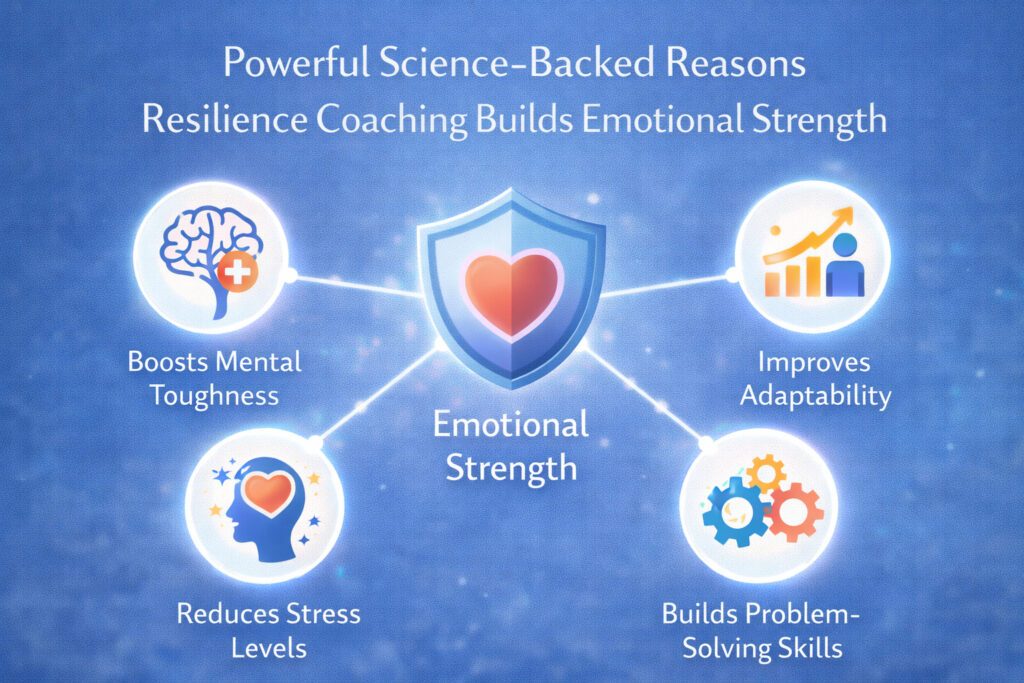
Resilience is not a personality trait you either have or lack. It is a trainable neurological and psychological capacity. Modern research shows that emotional strength can be developed through structured methods grounded in neuroscience, psychology, and behavioral science. This is where Resilience Coaching plays a measurable role.
Resilience develops when the brain repeatedly practices adaptive responses to stress rather than reactive ones. Studies in neuroscience show that guided reflection, emotional awareness, and controlled exposure to challenges strengthen neural circuits responsible for focus, emotional balance, and recovery.
Over time, these repeated patterns reshape how individuals perceive pressure, allowing them to respond with clarity instead of overwhelm.
This is where the Resilience Coaches become practical and measurable. By translating scientific insights into structured exercises and real-life applications, it helps individuals build emotional strength intentionally.
Instead of relying on motivation alone, coaching creates consistent habits that improve emotional control, decision-making, and long-term mental stability under stress.

Resilience Coaching and the Biology of Stress Response
Resilience Coaching works by targeting how the brain responds to stress. When faced with pressure, the amygdala triggers a threat response, while the prefrontal cortex manages reasoning and control.
Research shows coaching interventions strengthen neural pathways that improve emotional regulation science by:
• Reducing cortisol spikes
• Increasing vagal tone
• Enhancing prefrontal cortex activation
Key takeaway: Emotional resilience is biological, not motivational.
Read More: Resilience Coaching vs Therapy: What Is Better for You and Why It Matters Right Now
Resilience Coaching and Neuroplasticity Explained
| Emotional Regulation Principle | What Happens Without Coaching | How Resilience Coaching Trains It | Scientific Basis | Practical Outcome |
| Trigger Awareness | Emotional reactions occur automatically, often without conscious awareness | Clients learn to identify emotional triggers in real time through guided reflection and pattern recognition | Emotional regulation science shows that awareness reduces amygdala reactivity | Faster recognition of stress signals before escalation |
| Response Interruption | Stress leads to impulsive reactions such as avoidance or emotional outbursts | Coaching teaches pause techniques like breath regulation and cognitive stopping | Neuroscience confirms that brief pauses activate the prefrontal cortex | Reduced impulsive decisions under pressure |
| Emotional Labeling | Emotions feel overwhelming and difficult to manage | Clients practice naming emotions accurately instead of suppressing them | Studies show that faster nervous system recovery improves resilience | Greater emotional clarity and control |
| Adaptive Reframing | Situations are interpreted as threats, increasing anxiety | Coaching trains reframing challenges into manageable or meaningful tasks | Cognitive psychology links reframing to improved emotional stability | Improved confidence and emotional balance |
| Recovery Regulation | Emotional stress lingers and affects future performance | Clients learn structured recovery techniques after emotional disruption | Studies show faster nervous system recovery improves resilience | Quicker emotional reset and sustained performance |
Read More: Resilience Coaching: The Powerful Skill You Need to Survive a High-Stress World
Resilience Coaching as a Skill-Based Emotional Framework
Resilience Coaching focuses on skill acquisition rather than advice giving. Emotional strength develops through learning how emotions arise, peak, and pass.
Coaching frameworks are built on emotional regulation science principles, such as:
• Cognitive reappraisal
• Emotional labeling
• Nervous system stabilization
Summary: Emotional resilience improves through learned responses, not suppression.
Resilience Coaching and Evidence from Psychology Research
Resilience Coaching is supported by evidence from positive psychology, cognitive behavioral therapy, and stress research.
Peer-reviewed studies show participants experience:
• Improved emotional self-regulation skills
• Reduced burnout symptoms
• Increased adaptability under pressure
These outcomes validate coaching as an applied psychological intervention rather than a motivational trend.
Read More: How Resilience Coaching Gives You a Powerful Way to Overcome Stress and Boost Inner Strength
Resilience Coaching and Emotional Regulation Science in Practice
Resilience Coaching translates emotional regulation science into daily actions. Instead of abstract theory, clients practice regulating emotional intensity in real-time situations.
This includes:
• Recognizing emotional triggers
• Interrupting automatic reactions
• Choosing adaptive responses
Direct answer: Coaching trains emotional control through awareness, timing, and choice.
Resilience Coaching Techniques That Strengthen Emotional Control
Resilience Coaches use structured techniques that repeatedly activate calm and focus states in the nervous system.
Common evidence-backed tools include:
• Breath-based regulation protocols
• Cognitive reframing exercises
• Stress exposure simulations
These methods directly strengthen emotional self-regulation skills through repeated practice and feedback loops.
Read More: Proven Resilience Coaching That Helps You Beat Stress and Boost Confidence
Resilience Coaching and Long-Term Emotional Strength Development
Resilience Coaches differ from therapy by focusing on forward capacity rather than past healing.
Long-term benefits documented in organizational and clinical research include:
• Faster emotional recovery
• Higher stress tolerance
• Improved decision clarity
This confirms that emotional strength can be systematically built through coaching methodologies grounded in emotional regulation science.
Read More: How Resilience Coaching Gives You a Powerful Way to Overcome Stress and Boost Inner Strength
Resilience Coaching in High-Performance and Mental Health Contexts
Resilience Coaches are increasingly used in leadership development, healthcare, education, and mental wellness programs.
Applications include:
• Executive stress management
• Athlete performance conditioning
• Burnout prevention
Across contexts, improved emotional self-regulation skills consistently predict better performance and psychological stability.
How Resilience Coaching Improves Emotional Strength Step by Step
Resilience Coaching improves emotional strength by training the brain to regulate stress responses, reframe challenges, and recover faster from emotional disruption. Through repeated skill-based exercises, individuals strengthen neural pathways responsible for emotional balance, adaptability, and controlled decision-making.
Practical How-To Framework
• Identify emotional triggers
• Apply regulation techniques in real time
• Reflect and reinforce adaptive responses
FAQs
Q1.What makes Resilience Coaching evidence-based?
Resilience Coaching is grounded in neuroscience, psychology, and behavioral research. It applies validated methods from emotional regulation science and stress physiology rather than motivational advice.
Q2.How does Resilience Coaching differ from therapy?
Therapy focuses on healing past emotional wounds, while Resilience Coaching builds future-facing emotional capacity using skill training and structured practice.
Q3.Can emotional strength really be learned?
Yes. Research confirms emotional self-regulation skills improve through guided repetition, awareness training, and nervous system conditioning.
Q4.Can anyone improve their ability to handle stress?
Yes, research shows that stress management skills can be learned at any age. Techniques such as mindfulness, cognitive reframing, and adaptive coping strategies can strengthen emotional flexibility and resilience over time.
Q5. How long does it take to see results from emotional skills training?
The timeline varies depending on the individual and the consistency of practice. Many people notice improvements in emotional regulation, focus, and stress response within a few weeks, while long-term benefits continue to develop with regular practice.
Final Summary and Key Takeaways
Emotional resilience is not instinctive. It is scientific, trainable, and measurable.
Key insights:
• Emotional strength is rooted in brain biology
• Coaching strengthens neural regulation pathways
• Emotional regulation science validates coaching outcomes
• Emotional self-regulation skills improve with structured practice
Resilience Coaches stands at the intersection of neuroscience, psychology, and real-world application, making it a credible, evidence-backed approach to emotional strength development.
Start Your Transformation with Sukanya Debnath
If you’re ready to start your personal growth journey, begin with the best. Sukanya Debnath offers personalized, empathetic, and result-driven coaching programs that have transformed hundreds of lives.
Book a free consultation today and take the first step toward unlocking your true potential.