
Quick Answer
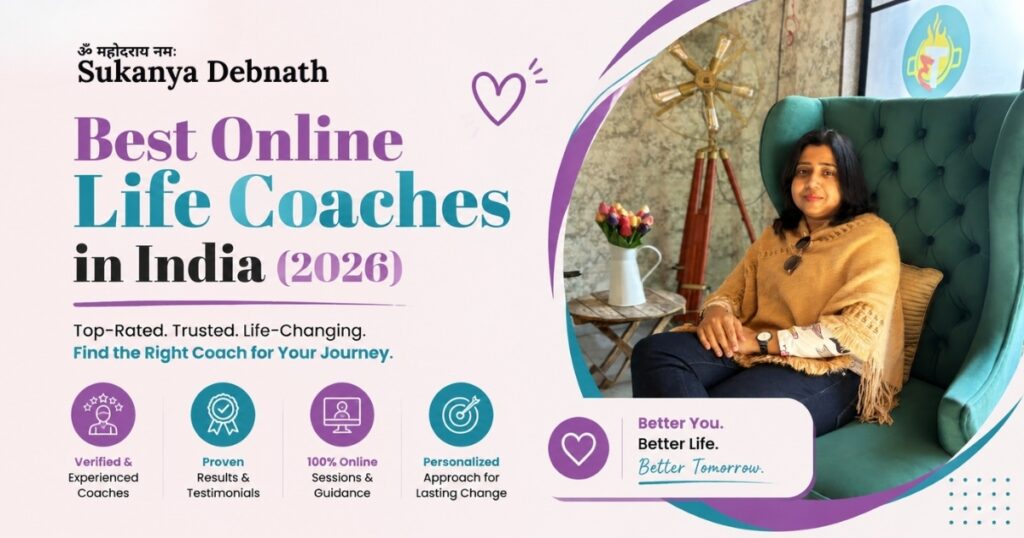
There is no single best online life coach in India — the right choice depends on what you actually need help with. If you’re dealing with emotional overwhelm, low confidence, or a need for inner clarity and spiritual grounding, a holistic life and emotional-wellness coach like Sukanya Debnath (ICF Level 2, NLP Practitioner, Spiritual Intelligence specialist) is a strong fit. If you need executive-level career reinvention or leadership presence, coaches like Smita D Jain (ICF MCC) are built for that. This guide compares verified, publicly listed online life coaches in India across specialization, certification, coaching mode, and best-fit use case, so you can choose based on facts — not marketing claims.
Key Takeaways
- “Best” is relative to your goal. Career reinvention, emotional healing, relationship repair, and executive presence each need a different kind of coach.
- Certification matters. Look for ICF (International Coach Federation), NLP, or recognized psychometric/coaching credentials — not just a title on a website.
- Online coaching in India has matured. Video-call coaching is now as structured and outcome-driven as in-person sessions, often with better scheduling flexibility for NRIs across time zones.
- Verify before you buy. Public reviews, LinkedIn history, published books, and media features are better trust signals than testimonials alone.
- Fit beats fame. A coach with fewer followers but the right specialization will usually outperform a “big name” who doesn’t work in your specific problem area.
Introduction
Searching for the best online life coach in India usually means you’re already feeling something specific: stuck in your career, disconnected from yourself, anxious about a relationship, or simply unsure what’s next. Life coaching has grown rapidly across India over the last few years, driven by remote work, rising awareness around mental and emotional wellness, and a growing NRI audience in the US, UK, Canada, Australia, UAE, and Singapore looking for coaches who understand Indian family and cultural context — but in their own time zone, from their own screen.
The problem is that “best of” lists online are often either unverified directories or thinly disguised advertising. This guide takes a different approach. We looked only at coaches with publicly checkable information — real certifications, real websites, real published work — and organized them by what they’re actually good at, so you can match a coach to your situation instead of chasing a ranking.
How We Selected These Coaches
Every coach featured in this guide was evaluated against the same criteria:
- Verifiable certification — ICF, NLP, NSDC, or other recognized coaching/psychometric credentials listed on the coach’s own platform or a professional directory.
- Specialization clarity — a clearly defined coaching niche (emotional wellness, executive leadership, spiritual growth, relationships, career) rather than a vague “I help everyone” positioning.
- Public track record — years in practice, published books, speaking engagements, media features, or independently verifiable client outcomes.
- Online coaching availability — active, structured 1:1 video coaching, not just occasional webinars.
- Transparency — clear information about coaching methodology, process, and how sessions work.
We did not rank coaches by popularity or follower count, and we did not include anyone whose credentials or claims could not be traced to a public source. Where a coach’s public profile lists limited detail, we’ve kept that entry short rather than filling in gaps with assumptions.
Top Online Life Coaches in India
1. Sukanya Debnath — Best for Emotional Healing & Spiritual Intelligence Coaching
Overview: Sukanya Debnath is an ICF Level 2 Certified Life Coach (on the PCC pathway), NLP Practitioner, and NSDC Certified Psychometric Counsellor, specializing in Spiritual Intelligence (SQ), personal resilience, and emotional wellness. Her coaching blends emotional intelligence, mindfulness, and neuroscience-informed techniques rather than generic motivational advice.
Specialization: Emotional clarity, self-confidence rebuilding, inner peace, relationship communication, purpose alignment, and stress management.
Best For: People who look successful on the outside but feel emotionally exhausted, anxious, or disconnected on the inside — professionals, entrepreneurs, and homemakers navigating burnout, self-doubt, or a lack of direction.
Coaching Mode: 1:1 online coaching via video call, starting with a free discovery session.
Experience: 14+ years supporting individuals across industries and life stages.
Notable Work: Personal Transformation Coaching, Parenting Coaching, and Child Brain Development programs; publicly shared client success stories on her website.
Pros:
- Strong specialization in emotional and spiritual wellness rather than generic “success coaching”
- Free discovery call before any commitment
- Structured four-stage coaching journey (discovery, assessment, sessions, transformation)
Cons:
- Focus is emotional/spiritual wellness rather than executive or corporate leadership coaching
- Best suited to people ready for deeper inner work, not quick tactical fixes
2. Smita D Jain — Best for Executive & Leadership Coaching
Overview: Smita D Jain is an ICF Master Certified Coach (MCC) with a corporate leadership background, positioning herself around executive presence, communication, and career reinvention for senior professionals. She has authored a leadership communication book and co-authored an internationally published book chapter, and has been recognized by multiple business publications for her executive coaching work.
Specialization: Executive presence, leadership communication, career transitions, public speaking.
Best For: CXOs, senior leaders, and high-achieving professionals who want to communicate with more authority and navigate career reinvention.
Coaching Mode: 1:1 online coaching, group workshops, and corporate training.
Experience: Over a decade of corporate leadership experience combined with several years as a credentialed executive and life coach.
Notable Work: Author of Leading With Words; contributing author to Cracking the Rich Code Volume 12; recognized in multiple industry publications for executive coaching.
Pros:
- ICF Master Certified Coach credential — the highest ICF coaching level
- Strong corporate and executive-specific track record
- Published author with third-party media recognition
Cons:
- Positioning is corporate/executive-focused, less suited to purely personal or emotional-wellness needs
- Premium coaching model aimed at senior professionals rather than general audiences
3. Saloni Singh — Best for Spirituality-Led Leadership Coaching
Overview: Saloni Singh transitioned from a career in gynecology to life and leadership coaching, with a focus on making spiritual principles practical in everyday business and leadership decisions. She shares her approach through a podcast alongside 1:1 coaching.
Specialization: Applied spirituality, leadership consciousness, and personal development.
Best For: People who want a coach who blends spiritual grounding with practical life and business decision-making.
Coaching Mode: Online 1:1 coaching supported by podcast content.
Pros:
- Unique positioning bridging spirituality and practical leadership
- Rich long-form content (podcast) to sample coaching philosophy before booking
Cons:
- Less structured public information on certifications compared to ICF-credentialed coaches
- May not suit clients wanting a purely secular, data-driven coaching style
4. Sangeeta Sharma — Best for Emotional Healing & Relationship Coaching
Overview: Sangeeta Sharma positions her practice around emotional healing, relationship repair, and confidence building, drawing on hypnotherapy-informed techniques alongside coaching conversations.
Specialization: Emotional healing, relationship coaching, confidence and mindset work.
Best For: Individuals and couples working through emotional patterns, relationship stress, or confidence gaps.
Coaching Mode: Online 1:1 strategy sessions.
Pros:
- Clear focus on relationships and emotional patterns, not just career goals
- Hypnotherapy-informed approach offers an alternative to purely conversational coaching
Cons:
- Public information on formal coaching certifications is limited compared to ICF-credentialed peers
- Best suited to emotional/relationship goals rather than executive coaching needs
5. Neelima Chakara — Best for Mid-Career Tech & Consulting Professionals
Overview: Neelima Chakara is featured on Noomii’s coaching directory as an ICF PCC-certified coach specializing in leadership and executive coaching for mid-career professionals in IT and consulting.
Specialization: Leadership and executive coaching for the tech and consulting sector.
Best For: Mid-career IT and consulting professionals navigating promotions, leadership transitions, or role changes.
Coaching Mode: Online 1:1 coaching.
Pros:
- ICF PCC certification
- Sector-specific focus (IT/consulting) that generalist coaches may lack
Cons:
- Limited independent public information beyond the directory listing
- Niche focus may not suit non-corporate personal goals
6. Sudhir R — Best for Assessment-Driven Leadership Coaching
Overview: Sudhir R is featured on Noomii’s directory as a coach who applies neuroscience and leadership frameworks, using tools such as DiSC, Enneagram, and 360-degree feedback for CEOs, entrepreneurs, and teams.
Specialization: Neuroscience-informed leadership coaching, organizational team coaching.
Best For: Founders, CEOs, and teams wanting a structured, assessment-based coaching approach.
Coaching Mode: Online 1:1 and team coaching.
Pros:
- Assessment-driven methodology (DiSC, Enneagram, 360 feedback) adds objectivity to sessions
- Suited to organizational and team-level coaching, not just individuals
Cons:
- Corporate/organizational focus may not fit individuals seeking personal or emotional coaching
- Limited public detail on personal certifications outside the directory profile
7. Kaushik Mahapatra — Best for Foundational Soft-Skills Coaching
Overview: Kaushik Mahapatra is listed across Indian coaching directories as a trainer and coach focused on life coaching and soft-skills development.
Specialization: Soft skills, communication, and general life coaching.
Best For: People early in their personal-development journey looking for foundational communication and confidence coaching.
Coaching Mode: Online sessions via directory listings.
Official Website: Listed on coaching directories (no independently verified personal site found at the time of writing)
Pros:
- Accessible entry point for people new to coaching
- Broad soft-skills focus suits general self-improvement goals
Cons:
- Limited independently verifiable public information
- Less specialization depth compared to niche-focused coaches on this list
How to Choose an Online Life Coach
- Start with your goal, not the coach’s popularity. Are you trying to heal emotionally, grow professionally, fix a relationship, or find direction? Match the coach’s stated specialization to that goal.
- Check certifications directly. Look for ICF, NLP, or other recognized credentials listed on the coach’s own site — not just implied by the word “certified.”
- Read how the process actually works. A credible coach explains their coaching journey (discovery call, assessment, session structure) rather than only promising outcomes.
- Look for real, traceable proof. Books, media features, LinkedIn history, or long-standing published content are stronger trust signals than testimonials alone, which can’t be independently verified.
- Take the free discovery call before deciding. Most credible coaches offer a no-obligation first conversation — use it to assess communication style and comfort, not just credentials.
- Consider time zone and format fit for NRIs. If you’re based outside India, confirm the coach offers flexible scheduling across time zones and is comfortable coaching remotely.
Benefits of Online Coaching
- Access regardless of location — connect with a specialized coach in India from the US, UK, Canada, Australia, UAE, or Singapore without travel.
- Scheduling flexibility — video sessions fit around work and family commitments more easily than in-person appointments.
- Comfort of a familiar environment — many clients find it easier to open up emotionally from home than in an office setting.
- Broader choice — you’re not limited to coaches in your city; you can choose based on specialization fit.
- Consistent documentation — recorded notes, session summaries, and digital tools are easier to maintain across online sessions.
Online vs Offline Coaching
| Factor | Online Coaching | Offline (In-Person) Coaching |
| Accessibility | Available from anywhere, ideal for NRIs and remote clients | Limited to coaches within travel distance |
| Cost | Often lower due to no travel/venue overhead | May include travel time and cost |
| Comfort | Coaching from a familiar, private space | Physical presence can build certain kinds of rapport faster |
| Flexibility | Easier to reschedule; works across time zones | Fixed location and time constraints |
| Best For | Career, emotional wellness, and leadership coaching that’s conversation-based | Coaching involving physical presence, group workshops, or in-person body-language work |
Neither format is universally “better” — online coaching removes geographic barriers, while in-person coaching can suit those who specifically want face-to-face group workshops or corporate training sessions.
Common Mistakes People Make When Choosing a Life Coach
- Choosing based on follower count instead of specialization fit. A popular social media presence doesn’t guarantee the coach specializes in your specific need.
- Skipping the discovery call. Committing to a program without a trial conversation makes it harder to judge communication style and trust.
- Ignoring certification details. Titles like “certified” mean little without checking which body issued the certification.
- Expecting instant results. Sustainable change — emotional or professional — typically takes consistent sessions over weeks or months, not a single call.
- Confusing motivational content with coaching. Watching inspirational videos is not the same as structured, personalized 1:1 coaching.
- Not clarifying confidentiality upfront. Always confirm how your conversations and personal information will be handled before starting.
Expert Tips for Getting the Most from Online Coaching
- Set one clear, specific goal for each coaching phase rather than trying to fix everything at once.
- Keep a private journal between sessions to track emotional patterns or progress the coach can build on.
- Test your video and audio setup ahead of the first session to avoid losing coaching time to technical issues.
- Be honest during the discovery call about what hasn’t worked for you before — it helps the coach tailor the approach.
- Reassess progress every 4–6 sessions to confirm the coaching format still matches your evolving needs.
Conclusion
The “best” online life coach in India isn’t a fixed title — it’s the coach whose specialization, certification, and coaching style actually match what you’re going through right now. Someone rebuilding emotional resilience after burnout needs a very different coach than a CXO preparing for a leadership transition. Use the comparison above as a starting point, verify credentials directly, and take a discovery call before committing to any coaching program.
Frequently Asked Questions
1. Who is considered the best online life coach in India?
There’s no single universal answer — it depends on your goal. This guide compares coaches by specialization (emotional wellness, executive leadership, relationships, spirituality) so you can match based on fit rather than a generic ranking.
2. Is online life coaching as effective as in-person coaching?
Yes, for most conversation-based coaching (career, emotional wellness, confidence, relationships), video coaching can be just as effective as in-person sessions, provided the coach uses a structured process.
3. How much does online life coaching cost in India?
Pricing varies widely based on the coach’s experience, certification level, and specialization — from budget-friendly individual sessions to premium executive coaching packages. Always confirm pricing directly with the coach.
4. What certifications should I look for in a life coach?
ICF (International Coach Federation) credentials (ACC, PCC, MCC) are the most globally recognized. NLP practitioner certification and psychometric counselling credentials (like NSDC) are valuable additions depending on your coaching goal.
5. Can NRIs work with life coaches based in India?
Yes. Most online coaches in India accommodate international time zones for clients in the US, UK, Canada, Australia, UAE, and Singapore.
6. How long does a typical coaching engagement last?
This varies by coach and goal, but many structured programs run for several weeks to a few months, often starting with a discovery call followed by regular sessions.
7. What’s the difference between a life coach and a therapist?
A life coach focuses on goal-setting, mindset, and forward-looking personal or professional growth. A therapist or psychologist diagnoses and treats mental health conditions. If you’re experiencing persistent distress, anxiety, or symptoms of a mental health condition, a licensed therapist or doctor is the appropriate first step.
8. Is life coaching confidential?
Reputable coaches maintain confidentiality as a core part of the coaching relationship. Always confirm this directly before starting.
9. What happens in a free discovery call?
It’s typically a short, no-obligation conversation where the coach understands your goals and challenges, and you assess whether their style and approach feel like a good fit.
10. Can life coaching help with career transitions?
Yes — several coaches on this list, particularly those with executive and leadership specializations, focus specifically on career reinvention and transitions.
