
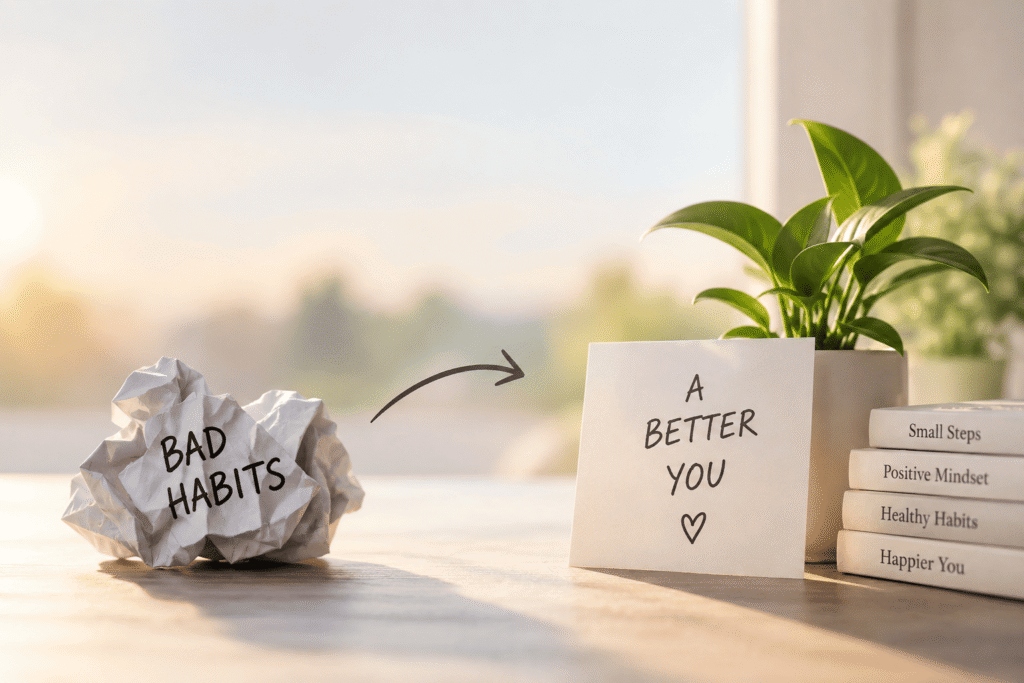
If you have ever promised yourself “from tomorrow, no more,” only to find yourself repeating the same behavior by evening, you are not lacking willpower. You are dealing with how the brain is designed to work. Learning how to change a bad habit starts with understanding how habits form in the first place, and then working with that system instead of fighting it.
How Habits Form
A habit is a behavior your brain has learned to run on autopilot. Your brain constantly looks for ways to save energy, so when you repeat an action in the same situation and it gives you some kind of reward, the brain begins to bundle it into an automatic routine. Over time, you stop deciding and simply do.
Most habits follow a simple loop:
Cue: something that sets the behavior off, such as a time of day, a place, an emotion, or a person.
Routine: the behavior itself, whether that is scrolling your phone, snacking, biting your nails, or lashing out in an argument.
Reward: the benefit you get, such as relief, comfort, distraction, or a sense of connection.
This loop is why bad habits feel so stubborn. They are not random. They are meeting a need, even if in an unhelpful way. And there is no fixed number of days after which a habit is guaranteed to disappear. How long change takes depends on the habit, your circumstances, how often you repeat the new behavior, and how much support you have. So drop the countdown and focus on the process.
If you’re looking for practical guidance to overcome emotional challenges, build self-confidence, and gain greater clarity in life, Sukanya Life Coach can support you on your personal growth journey. With personalised one-to-one coaching, you can explore your challenges, understand limiting patterns, and work towards meaningful and lasting change. Book a Discovery Call with Sukanya Debnath today and take the first step towards a more confident, balanced, and purposeful life.
Step 1: Identify Your Triggers
The first step in how to change a bad habit is to notice what sets it off. For a week or two, simply observe without judging yourself. Each time the habit shows up, ask:
- Where am I?
- What time is it?
- How am I feeling emotionally?
- Who is around me?
- What happened right before?
Patterns usually appear quickly. You may find that you reach for junk food not when you are hungry but when you are stressed after work, or that you check social media whenever you feel bored or avoid a task. Once you can name the trigger, the habit stops feeling mysterious and starts feeling manageable.
Step 2: Understand the Routine and the Reward
Next, get honest about what the habit is actually giving you. This is the step most people skip. Ask yourself: what am I really seeking here?
Late-night scrolling might be about escaping a busy mind. Smoking might be about taking a break, or social bonding. Procrastination might be protecting you from fear of failure. When you understand the real need behind the behavior, you can find healthier ways to meet it. If you only try to remove the habit without addressing the need, the need will simply find another outlet.
Step 3: Replace the Behavior, Don’t Just Remove It
Willpower alone rarely works because it leaves a gap. A more effective approach is to keep the same cue and the same underlying reward, but swap in a healthier routine.
If stress triggers snacking, try a short walk, a glass of water, or a few minutes of deep breathing.
If boredom triggers phone scrolling, keep a book or a puzzle within reach.
If anger triggers harsh words, practice pausing for three slow breaths before responding.
The replacement should feel realistic and at least somewhat satisfying. If it feels like punishment, it will not last. It also helps to make the old habit harder to do by adding a little friction, like deleting an app, moving snacks out of sight, or logging out of accounts. At the same time, make the new behavior easy and visible.
Step 4: Start Small
One of the most common mistakes is trying to overhaul everything at once. Big goals feel motivating on day one and overwhelming by day five. Instead, shrink the change until it feels almost too easy.
Rather than “I will never eat sugar again,” try “I will skip sugar in my evening tea.” Rather than “I will stop wasting time on my phone,” try “I will keep my phone out of the bedroom at night.” Small wins build confidence, and confidence builds momentum. Once a small change feels natural, you can gradually build on it.
Linking the new behavior to something you already do also helps. For example, “After I finish dinner, I will take a ten-minute walk.” Attaching a new routine to an existing one gives it a clear place in your day.
Step 5: Track Your Progress
What gets measured tends to improve. Tracking makes your progress visible, and progress is motivating. You do not need anything fancy. A notebook, a calendar with check marks, or a simple notes app on your phone will do.
Track things that matter to you, such as how often you used the replacement behavior, how many times you noticed the trigger, or how you felt afterward. Do not focus only on perfect streaks. If you count only unbroken streaks, one slip can make everything feel wasted. Instead, look at the bigger picture: are you doing the new behavior more often than you were a few weeks ago? That is real progress.
Step 6: Deal With Setbacks Without Giving Up
Setbacks are a normal part of change, not proof of failure. Almost everyone slips at some point, especially during stress, illness, travel, or major life changes. What matters most is what you do next.
Here are a few ways to handle a lapse:
- Respond with curiosity, not criticism. Harsh self-talk often makes the habit stronger, because guilt is itself a common trigger. Ask instead, “What was happening right before this? What can I learn?”
- Get back on track at the very next opportunity. One missed day does not erase your effort. Avoid the “I’ve already ruined it” thinking.
- Adjust your plan. If a setback keeps happening in the same situation, that trigger needs a stronger strategy.
- Plan for high-risk moments. Know in advance which situations are hardest, and decide ahead of time what you will do.
Get Support Where You Need It
You do not have to do this alone. Sharing your goal with a trusted friend or family member can add accountability and encouragement. For habits that feel deeply rooted or tied to strong emotions, working with a coach can make a real difference. A coach helps you spot patterns you may not see yourself, build a plan that fits your life, and stay steady when motivation dips. This is the kind of guidance that Sukanya Life Coach offers, helping people understand the “why” behind their habits and build sustainable change at their own pace.
If a habit is connected to addiction, serious anxiety, depression, or self-harm, please reach out to a qualified doctor or mental health professional.
Final Thoughts
Learning how to change a bad habit is not about becoming a different person overnight. It is about noticing your triggers, understanding what your habit gives you, replacing it with something healthier, starting small, tracking your progress, and being kind to yourself when things go off track. There is no magic number of days, only steady practice and patience.
Begin with one habit, one trigger, and one small step today. If you would like personal support along the way, Sukanya Life Coach is here to help you build habits that truly last.
